
Embark on a journey through the realm of Sustainable Investment Strategy, where financial prosperity meets environmental consciousness. This captivating narrative delves into the intricacies of sustainable investing, offering a glimpse into a world where profits align with planet-friendly practices.
Explore the components, factors, and implementation of sustainable investment strategies, uncovering the key elements that drive success in this evolving landscape.
What is Sustainable Investment Strategy?
A sustainable investment strategy refers to the practice of considering environmental, social, and governance (ESG) factors in investment decisions alongside financial factors. This approach aims to generate long-term value for investors while also promoting positive social and environmental impacts.
It is important to incorporate sustainability into investment decisions to address pressing global issues such as climate change, social inequality, and resource depletion. By integrating ESG considerations into investment strategies, investors can not only contribute to a more sustainable future but also potentially achieve better financial returns.
Benefits of Sustainable Investment Strategies
- Improved risk management: By considering ESG factors, investors can identify and mitigate potential risks related to environmental and social issues, ultimately safeguarding their investments.
- Enhanced reputation: Investing in companies with strong sustainability practices can enhance an investor’s reputation and appeal to socially conscious clients or stakeholders.
- Long-term value creation: Companies that prioritize sustainability are more likely to be resilient in the face of changing market dynamics, leading to long-term value creation for investors.
- Positive impact: Sustainable investment strategies can drive positive social and environmental outcomes, such as reducing carbon emissions, promoting diversity and inclusion, and supporting community development.
Components of a Sustainable Investment Strategy
A sustainable investment strategy involves various key components that focus on long-term financial returns while considering environmental, social, and governance (ESG) factors.
Integration of ESG Factors
- Environmental Factors: These include the impact of a company’s operations on the environment, such as carbon footprint, waste management, and resource usage.
- Social Factors: This involves evaluating how a company manages relationships with employees, communities, and other stakeholders, considering aspects like diversity, labor practices, and human rights.
- Governance Factors: Governance looks at the leadership structure, executive pay, shareholder rights, and overall transparency and accountability within a company.
Role of Impact Investing
Impact investing is a key component of a sustainable investment strategy, focusing on generating positive social and environmental impact alongside financial returns. This approach involves investing in companies, organizations, and funds that aim to address specific social or environmental issues while delivering financial gains.
Factors Influencing Sustainable Investment Strategies
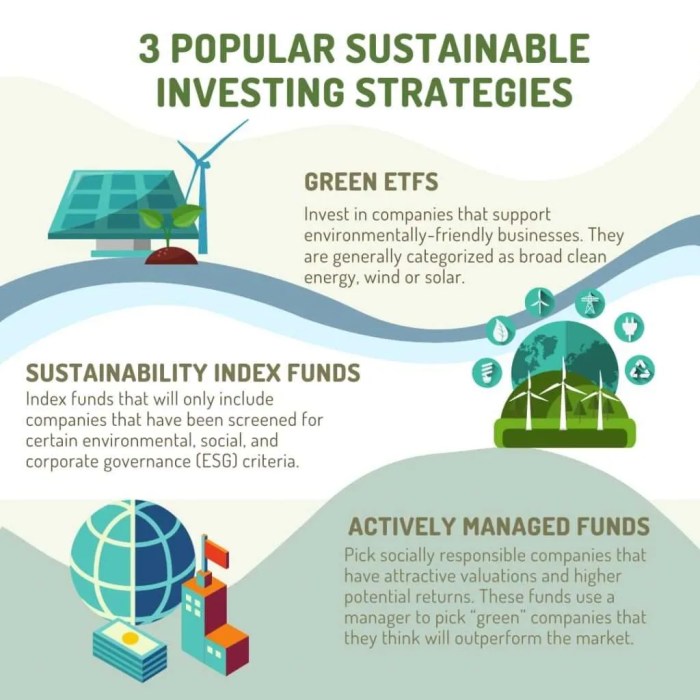
When it comes to sustainable investment strategies, there are various factors that play a crucial role in shaping the decisions of investors and corporations alike. These factors can range from regulatory changes to consumer preferences and market trends.
Regulatory Changes Impacting Sustainable Investment Strategies
Regulatory changes have a significant impact on sustainable investment strategies as they can create a framework that encourages or mandates sustainable practices. For example, government policies that promote renewable energy or carbon pricing can influence investment decisions towards more sustainable options.
Consumer Preferences and Market Trends
- Consumer preferences: Increasing awareness and demand for sustainable products and services have led to a shift in consumer preferences towards companies that prioritize sustainability. This has prompted investors to consider the environmental and social impact of their investments.
- Market trends: The rise of ESG (Environmental, Social, and Governance) investing has gained traction in recent years, with more investors looking to incorporate ESG factors into their decision-making process. This trend has influenced the overall adoption of sustainable investment strategies.
Role of Corporate Sustainability Practices
Corporate sustainability practices also play a crucial role in shaping investment decisions. Companies that prioritize sustainability and responsible business practices are more likely to attract investors who value long-term sustainability goals. By integrating sustainability into their operations, companies can enhance their reputation and appeal to socially responsible investors.
Implementation of Sustainable Investment Strategies
Implementing sustainable investment strategies involves several key steps to ensure that environmental, social, and governance (ESG) factors are integrated into investment decisions.
Steps in Implementing a Sustainable Investment Strategy
- Conducting ESG analysis: This involves evaluating companies based on their environmental impact, social responsibility, and governance practices.
- Setting investment criteria: Establishing clear guidelines for selecting investments that align with sustainability goals.
- Portfolio construction: Building a diversified portfolio that includes companies with strong ESG performance.
- Engagement and advocacy: Engaging with companies to encourage better ESG practices and voting on shareholder resolutions.
- Monitoring and reporting: Regularly monitoring the ESG performance of investments and reporting on progress towards sustainability targets.
Challenges Faced by Investors
- Lack of standardized metrics: Difficulty in comparing ESG performance across companies due to the lack of consistent reporting standards.
- Short-term focus: Pressure to deliver immediate financial returns may conflict with long-term sustainability goals.
- Limited data availability: Inadequate data on ESG factors can make it challenging to assess the impact of investments.
Successful Case Studies
One notable example of successful implementation of sustainable investment strategies is the California State Teachers’ Retirement System (CalSTRS). They have integrated ESG considerations into their investment process and actively engage with companies to drive positive change.
CalSTRS has seen improved long-term performance by investing in companies with strong ESG practices, demonstrating the financial benefits of sustainability.
Investment Advice and Sustainable Strategies
Investment advisors play a crucial role in guiding clients towards sustainable investment strategies by providing expertise, knowledge, and recommendations tailored to their financial goals and values.
Aligning Investment Advice with Client’s Values
Investment advisors help clients align their investment decisions with their values and sustainability goals by offering personalized advice that takes into account environmental, social, and governance (ESG) factors. By understanding what matters most to the client, advisors can recommend investments that support causes the client cares about while also achieving financial returns.
- Consider working with a Certified Financial Planner (CFP) or Chartered Financial Analyst (CFA) who specializes in sustainable investing.
- Ask about the advisor’s experience with ESG investing and inquire about their track record in recommending sustainable investments.
- Look for advisors who are transparent about their investment process and how they incorporate ESG factors into their recommendations.
- Seek referrals from other clients who have similar values and investment goals to ensure the advisor can meet your needs.
- Evaluate the advisor’s commitment to ongoing education and staying up-to-date on sustainable investing trends and best practices.
Evaluating the Credibility of Investment Advisors
It is essential for investors to assess the credibility of investment advisors offering sustainable investment advice to ensure they are receiving accurate and reliable recommendations.
- Review the advisor’s credentials and certifications related to sustainable investing, such as the Chartered SRI Counselor (CSRIC) designation.
- Ask for case studies or examples of successful sustainable investments the advisor has recommended to other clients.
- Inquire about the advisor’s investment philosophy and how they integrate ESG factors into their analysis and decision-making process.
- Check if the advisor is a member of industry organizations focused on sustainable investing, such as the Global Impact Investing Network (GIIN) or the Principles for Responsible Investment (PRI).
- Consider the advisor’s reputation in the industry and seek feedback from other clients or professionals in the sustainable investing community.
Investment Horizons in Sustainable Investing
Investment horizon refers to the length of time an investor expects to hold an investment before selling it. In the context of sustainable investing, the investment horizon plays a crucial role in determining the success of sustainable investment strategies.
Long-Term Perspectives in Sustainable Investing
- Long-term perspectives in sustainable investing allow investors to align their investments with their values and long-term goals.
- By focusing on long-term outcomes, investors can support companies that prioritize environmental, social, and governance (ESG) criteria, leading to positive impacts over time.
- Long-term perspectives also enable investors to weather short-term market fluctuations and benefit from the compounding effect of sustainable investments.
Managing Risk and Return Expectations
- One strategy for managing risk over different investment horizons is diversification, spreading investments across a range of sustainable assets to reduce exposure to any single risk.
- Setting realistic return expectations based on the chosen investment horizon is crucial for sustainable investing success, as short-term fluctuations may not accurately reflect the long-term potential of sustainable investments.
- Regularly reviewing and adjusting the investment portfolio based on changes in the investment horizon and market conditions can help investors stay aligned with their long-term goals.
Investment Opportunities in Sustainable Sectors
Investing in sustainable sectors not only aligns with ethical values but also presents lucrative opportunities for investors to grow their portfolios while making a positive impact on the environment and society. As the world shifts towards a more sustainable future, various sectors are emerging as hotspots for investment, offering potential growth and innovation.
Renewable Energy
Renewable energy is a key sector within sustainability, with a focus on sources such as solar, wind, hydro, and geothermal power. Investing in companies involved in renewable energy production and technology development can provide significant returns while contributing to the global transition to clean energy.
- Companies specializing in solar panel manufacturing and installation, like SunPower Corporation and First Solar, offer investment opportunities in the solar energy sector.
- Wind energy companies such as Vestas Wind Systems and Siemens Gamesa Renewable Energy are leaders in the wind power industry, providing promising investment options.
- Investing in innovative battery technology companies like Tesla, Inc. can also be a strategic move to support the growth of renewable energy storage solutions.
Sustainable Agriculture
Sustainable agriculture focuses on environmentally friendly farming practices, resource conservation, and organic food production. Investors can explore opportunities in companies that promote sustainable agriculture techniques, produce organic food, or develop agricultural technologies that minimize environmental impact.
- Investing in companies like Beyond Meat and Impossible Foods, which offer plant-based meat alternatives, taps into the growing trend of sustainable and ethical food consumption.
- Agtech companies like Indigo Agriculture, which develops innovative solutions for crop yield optimization and soil health improvement, present investment opportunities in sustainable agriculture.
- Companies engaged in precision farming technologies, such as Deere & Company (John Deere), are at the forefront of sustainable agriculture practices, offering potential for growth and impact.
Impact Investing
Impact investing involves allocating capital to companies, organizations, and funds with the intention to generate positive social and environmental impact alongside financial returns. This approach allows investors to support initiatives that address critical sustainability challenges while earning a profit.
- Investing in green bonds issued by companies committed to environmentally sustainable projects can provide a way to support climate action while earning fixed income returns.
- Venture capital funds focused on impact investing, like Social Capital, provide opportunities to invest in startups and early-stage companies driving positive change in various sectors.
- Supporting community development financial institutions (CDFIs) through investments can promote economic empowerment and social inclusion while generating financial returns for investors.
Evaluating the Success of a Sustainable Investment Strategy
Investors often use various metrics and key performance indicators to measure the success of a sustainable investment strategy. These metrics go beyond traditional financial returns and focus on the impact of investments on environmental, social, and governance (ESG) factors.
Metrics and Key Performance Indicators
- Carbon footprint reduction: Measuring the amount of carbon emissions reduced or avoided by sustainable investments.
- ESG ratings: Tracking the performance of companies in terms of environmental impact, social responsibility, and corporate governance.
- Impact on communities: Evaluating the positive influence of investments on local communities through job creation, infrastructure development, or social programs.
- Resource efficiency: Assessing how efficiently resources are used in the production processes of invested companies.
Challenges of Quantifying Impact
- Subjectivity: Measuring the non-financial impact of sustainable investments can be subjective and vary depending on individual perspectives.
- Data availability: Limited availability of consistent and reliable data on ESG factors can make it challenging to accurately quantify the impact of investments.
- Long-term effects: Some benefits of sustainable investments, such as environmental conservation or social development, may take time to materialize and be difficult to measure in the short term.
Tracking and Evaluating Performance
- Regular ESG reporting: Investors can require companies to provide transparent ESG reports to track their progress and impact on sustainability factors.
- Comparative analysis: Comparing the performance of sustainable investments with traditional financial benchmarks can help investors assess the relative success of their portfolios.
- Engagement with companies: Engaging with invested companies to understand their ESG practices and the impact of sustainability initiatives can provide valuable insights for evaluation.
In conclusion, Sustainable Investment Strategy emerges as a beacon of hope for investors seeking both monetary gains and eco-friendly solutions. By embracing sustainability in investment decisions, individuals can pave the way towards a brighter, more prosperous future for all.
Commonly Asked Questions
What are the key components of a sustainable investment strategy?
The key components include integrating environmental, social, and governance factors, understanding impact investing, and aligning investments with sustainability goals.
How can investors evaluate the credibility of advisors offering sustainable investment advice?
Investors can evaluate credibility by assessing the advisor’s track record in sustainable investing, understanding their values alignment, and verifying any certifications or expertise in the field.
What metrics are used to measure the success of a sustainable investment strategy?
Metrics such as ESG ratings, carbon footprint reductions, social impact assessments, and alignment with sustainability goals are commonly used to gauge the success of sustainable investment strategies.


