What is Investment Banking? sets the stage for this enthralling narrative, offering readers a glimpse into a story that is rich in detail and brimming with originality from the outset.
Investment banking plays a crucial role in the financial market, providing various services and opportunities for investors to explore.
What is Investment Banking?
Investment banking plays a crucial role in the financial market by facilitating the flow of capital between investors and corporations. These banks provide various financial services to help companies raise capital, manage risks, and facilitate mergers and acquisitions.
Role of Investment Banks in the Financial Market
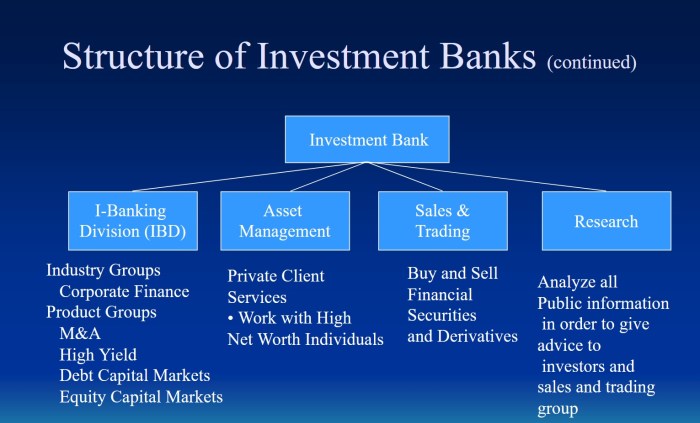
Investment banks act as intermediaries between companies and investors, helping businesses raise funds through issuing stocks and bonds. They also provide financial advisory services, including mergers and acquisitions, restructuring, and risk management.
Services Offered by Investment Banks
- Underwriting: Investment banks help companies issue new securities by purchasing them and reselling them to investors.
- Financial Advisory: They provide strategic advice on mergers, acquisitions, and other financial transactions.
- Trading and Market Making: Investment banks facilitate trading of securities and provide liquidity in the markets.
- Asset Management: Some investment banks offer asset management services to institutional and individual clients.
Major Investment Banks Globally
- Goldman Sachs
- J.P. Morgan Chase
- Morgan Stanley
- Bank of America Merrill Lynch
- UBS
Difference Between Commercial Banking and Investment Banking
Investment banks focus on providing financial services to corporations, institutional clients, and high-net-worth individuals, while commercial banks primarily deal with retail banking services for individuals and small businesses. Investment banks are more involved in capital markets activities, such as underwriting, trading, and advisory services, whereas commercial banks focus on traditional banking activities like deposits, loans, and mortgages.
Investment Advice

Seeking investment advice is crucial for individuals looking to make informed financial decisions and maximize their returns. Investment advisors play a significant role in guiding clients through the complex world of investing, helping them navigate risks and opportunities to achieve their financial goals.
Importance of Seeking Investment Advice
- Investment advisors provide personalized guidance based on individual financial situations and goals.
- They offer expertise in analyzing market trends and identifying investment opportunities.
- Advisors help clients develop a diversified investment portfolio to manage risk effectively.
Examples of Situations Where Investment Advice is Beneficial
- Planning for retirement and creating a sustainable income stream.
- Managing windfall gains, such as inheritance or lottery winnings, to ensure long-term financial stability.
- Navigating market volatility and economic downturns to protect and grow investment assets.
Qualifications and Certifications for Investment Advisors
- Financial advisors typically hold certifications such as Certified Financial Planner (CFP) or Chartered Financial Analyst (CFA).
- Advisors are required to adhere to strict ethical standards and regulatory guidelines to ensure client protection.
- Ongoing education and training are essential for advisors to stay updated on market trends and investment strategies.
Investment Horizon
Investment horizon refers to the time period over which an investor expects to achieve a particular financial goal through an investment. It is a crucial factor in investment planning as it influences the selection of appropriate investment vehicles and strategies based on the individual’s financial objectives and risk tolerance.
Significance of Investment Horizon
- Affects Risk Tolerance: Longer investment horizons typically allow for a higher tolerance for risk as there is more time to recover from any market fluctuations.
- Impacts Return Expectations: Shorter investment horizons may require investments with quicker returns, while longer horizons can accommodate growth-oriented investments.
- Determines Asset Allocation: Investment horizon influences the allocation of assets between stocks, bonds, and other securities to achieve the desired financial goals.
Factors Influencing Investment Horizon
- Age: Younger individuals may have longer investment horizons due to more time to accumulate wealth and recover from market downturns.
- Financial Goals: Short-term goals like buying a house may require a shorter investment horizon, while retirement planning may involve a longer horizon.
- Risk Tolerance: Those with a higher risk tolerance may opt for longer investment horizons to capitalize on market growth potential.
Examples of Investment Horizons
- Long-Term: Saving for retirement, education funds for children, building wealth over several decades.
- Short-Term: Saving for a vacation, emergency fund, down payment on a house within a few years.
Investment Opportunities
When it comes to investing, there are various opportunities available to investors. It is essential to understand the different types of investments, how to evaluate them, and the associated risks in order to make informed decisions.
Types of Investment Opportunities
- Stocks: Investing in shares of publicly traded companies.
- Bonds: Loaning money to governments or corporations in exchange for interest payments.
- Real Estate: Buying properties for rental income or capital appreciation.
- Mutual Funds: Pooling money with other investors to invest in a diversified portfolio.
Evaluating and Analyzing Investment Opportunities
Before investing, it is crucial to conduct thorough research and analysis to assess the potential returns and risks of an investment opportunity. Factors such as market trends, financial performance, and economic indicators play a significant role in the evaluation process.
Risks Associated with Investment Opportunities
- Market Risk: Fluctuations in the market can affect the value of investments.
- Interest Rate Risk: Changes in interest rates can impact bond prices.
- Inflation Risk: Rising inflation can erode the purchasing power of returns.
Emerging Investment Opportunities
With advancements in technology and changing market dynamics, new investment opportunities continue to emerge. Examples include:
- Cryptocurrency: Digital assets like Bitcoin and Ethereum gaining popularity.
- Sustainable Investing: Investing in companies focused on environmental and social responsibility.
- Artificial Intelligence: Opportunities in AI-related industries for growth and innovation.
Investment Strategy
Investment strategy refers to a plan or approach used by investors to achieve their financial goals while managing risk effectively. It is crucial to have a well-defined investment strategy to make informed decisions and maximize returns over time.
Growth Investing
- Growth investing focuses on investing in companies that are expected to grow at an above-average rate compared to the overall market.
- Investors following this strategy typically target companies with strong potential for expansion and revenue growth.
- They are willing to pay a premium for stocks of these companies in anticipation of future price appreciation.
Value Investing
- Value investing involves selecting undervalued stocks that are trading below their intrinsic value.
- Investors following this strategy look for opportunities where the market has undervalued a company’s stock.
- They aim to buy low and sell high when the market corrects the valuation of the stock.
Income Investing
- Income investing focuses on generating a steady stream of income from investments such as dividend-paying stocks, bonds, or real estate.
- Investors following this strategy prioritize regular income payments over capital appreciation.
- They seek out investments with stable and reliable income streams to meet their financial needs.
Developing a Personalized Investment Strategy
To develop a personalized investment strategy based on financial goals, investors should:
- Assess their risk tolerance and investment timeline.
- Determine their financial objectives, whether it is growth, income, or capital preservation.
- Allocate assets across different investment types to diversify risk.
- Regularly review and adjust the strategy as needed based on changing market conditions and personal circumstances.
Examples of Successful Investment Strategies
Warren Buffett’s value investing approach has made him one of the most successful investors of all time, focusing on buying undervalued companies with strong fundamentals.
Peter Lynch’s growth investing strategy at Fidelity Magellan Fund led to significant returns by investing in companies with high growth potential.
John Bogle’s passive investing strategy with index funds at Vanguard challenged traditional active management and became a popular choice for long-term investors.
In conclusion, What is Investment Banking? delves into the intricate world of finance, shedding light on the dynamic nature of investment strategies and the significance of seeking professional advice.
Common Queries
What qualifications do you need to become an investment advisor?
To become an investment advisor, you typically need a bachelor’s degree in finance or a related field, along with relevant certifications like the Series 7 and Series 65 licenses.
What are some examples of major investment banks globally?
Major investment banks globally include Goldman Sachs, JPMorgan Chase, Morgan Stanley, and Citigroup.
What is the difference between commercial banking and investment banking?
Commercial banking focuses on traditional banking services like deposits and loans, while investment banking deals with raising capital for corporations, underwriting securities, and providing M&A advisory services.


